

Prostate enlargement, also known as Benign Prostatic Hyperplasia (BPH), is a common condition among men, especially those over 50. This non-cancerous condition can disrupt urinary health and lead to serious complications if left untreated. Learn everything about BPH, including its symptoms, diagnosis, and effective treatment options in Singapore.

Dr Jay Lim
MBBS (Syd), MRCS (Edin), MRCS (Glasg), MMed (NUS), FAMS (Urology)
Dr Lim Kheng Sit (Jay) is a BPH specialist in Singapore with expertise in prostate enlargement treatment, such as Rezum™ water vapour therapy, as well as MRI-guided targeted prostate biopsy using the Biobot™ platform.
With over a decade of experience across public and private healthcare systems, Dr Lim brings both technical training and a patient-centred approach to enlarged prostate assessment and management, from initial evaluation to procedure care and follow up. He is committed to addressing BPH symptoms with reduced impact on recovery and quality of life.
The prostate gland is a key part of the male reproductive system, located just below the bladder and surrounds the urethra, the tube that carries urine out of your body.
BPH occurs when non-cancerous prostate tissue enlarges, particularly within the transition zone surrounding the urethra. As this tissue grows, it may narrow the urinary channel and make urination more difficult. BPH is not prostate cancer, although both conditions can occur in the same person.
Prostate size in grams does not always correspond to symptom severity. You may have a relatively small prostate but troublesome symptoms, or a larger prostate with few urinary problems.
BPH symptoms generally fall into two groups: difficulties passing urine and difficulties storing urine in your bladder.

These occur when urine has difficulty passing through the narrowed urinary channel.
You may also notice terminal dribbling, where urine continues dripping after you think you have finished, or find yourself straining to urinate.
These affect how frequently and urgently you need to urinate.
Nocturia can be particularly disruptive. You may wake several times each night, struggle to fall back asleep, or feel tired the next day. Repeated nighttime trips to the bathroom can also increase your risk of falling, particularly if you are older.
However, nocturia is not always caused by BPH. Your urologist may also consider diabetes, sleep conditions, medication use and how much fluid you drink before bedtime.
Your urologist may use the International Prostate Symptom Score (IPSS) to understand how much your symptoms affect you.
This seven-question questionnaire gives a score out of 35:
Your IPSS score helps indicate the severity of your urinary symptoms alongside how much they affect your quality of life. A higher score does not automatically mean you need surgery.
BPH is associated with hormonal changes as men age.
An enzyme called 5-alpha reductase converts testosterone into dihydrotestosterone (DHT), which contributes to prostate tissue growth. Over time, DHT can promote enlargement of the transition zone surrounding the urethra, potentially restricting urine flow.
Age is an important risk factor, but it is not the only one.
Your risk may also be associated with:
These factors are associated with prostate enlargement and lower urinary tract symptoms, although having them does not mean you will necessarily develop troublesome BPH.
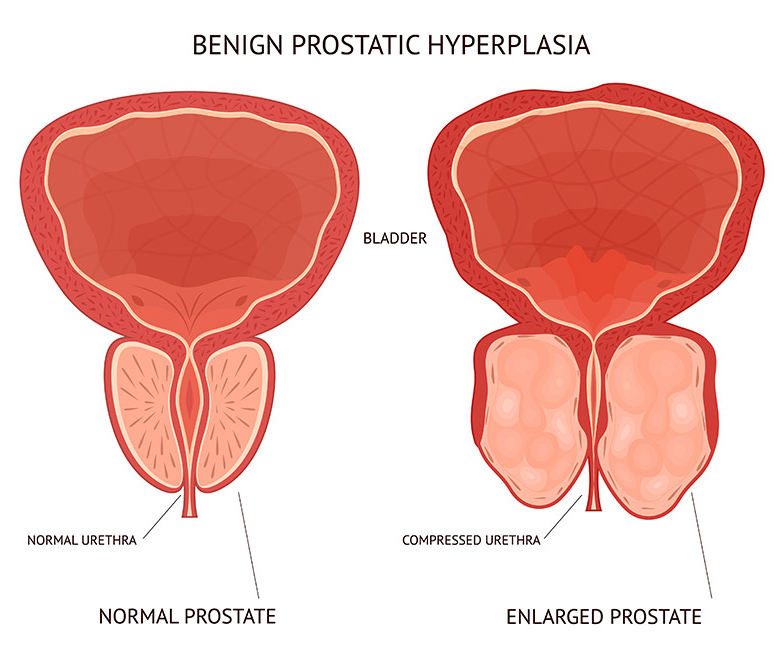
You may be tempted to put up with urinary symptoms, especially if they develop gradually. However, persistent obstruction can affect your bladder and, in more severe cases, your kidneys. Possible complications include acute urinary retention, recurrent urinary tract infections, bladder stones and hydronephrosis, where urine backs up and causes kidney swelling.
Early intervention through lifestyle changes or medical procedures can restore urinary health and improve overall well-being. Nocturia is a significant risk factor for fall in the elderly. Tripping on furniture in a dark room can be catastrophic, especially if on blood thinning medications. Improving the overall sleep quality also improves quality of life for the elderly.
If you suddenly cannot pass urine, seek emergency medical attention.
Your first consultation usually involves discussing your urinary symptoms, medical history and medications, followed by an examination and selected tests.
Your urologist will also ask how much your symptoms affect your sleep, work and daily activities. The appointment duration depends on which investigations you need.
A doctor reviews symptoms and performs a digital rectal exam to assess prostate size. A bladder ultrasound is usually performed to measure the size of the prostate. A PSA is also performed to ensure the prostate is free from cancer in the same setting.
Patients track urination patterns over 72 hours, including fluid intake and nocturnal voiding may be required.
Urodynamics assesses how your bladder stores and releases urine. It is generally reserved for selected cases where the diagnosis remains unclear, bladder function needs further assessment or earlier treatment has not worked as expected.
During uroflowmetry, you urinate into a specialised device that measures how quickly urine flows. An ultrasound may then measure how much urine remains in your bladder after urination.
Your peak flow rate and residual urine volume help your urologist assess bladder emptying and guide treatment.
If you think you may be presenting symptoms of BPH, schedule a consult as soon as possible.
BPH treatment depends on your IPSS score, prostate volume, examination findings and how much your symptoms affect you.
Your urologist will also consider whether preserving ejaculatory function matters to you and whether you take anticoagulants or other medications that increase bleeding risk.
Enlarged prostate treatment in Singapore may involve lifestyle adjustments, medications, or a surgical procedure.
If your symptoms are mild, practical changes may help:
Medication may help when lifestyle changes are insufficient. Depending on your symptoms and prostate size, your urologist may recommend:
If medication does not provide sufficient relief, causes troublesome side effects or complications develop, your urologist may discuss enlarged prostate surgery in Singapore.
The cost of treatment depends on whether you need medication, a minimally invasive procedure or surgery. Different procedures also involve different equipment, admission requirements and recovery needs.
Your total bill may include consultation and diagnostic tests, medication, procedure fees, anaesthesia, hospital or day surgery charges, catheter care and follow-up appointments.
We can provide a more relevant estimate once your urologist has assessed your prostate and recommended treatment.
Eligible BPH procedures may be claimable under MediSave, MediShield Life or an Integrated Shield Plan, subject to the applicable rules and policy terms.
MediSave surgical withdrawal limits depend on the procedure’s classification under Singapore’s Table of Surgical Procedures.
For eligible inpatient or day surgery episodes, the claimable amount includes the applicable daily hospital charge limit and surgical limit, subject to prevailing rules.
Check your insurer’s panel arrangements, pre-authorisation requirements and co-payment before treatment.
Consider consulting a BPH specialist in Singapore if you:
Led by an experienced urologist, our clinic focuses on conditions affecting the prostate, kidney, bladder, and male reproductive conditions, ensuring patients receive targeted, specialist care.
Most of our procedures are claimable by integrated shield and corporate insurance plans, making treatment more accessible and providing greater peace of mind.
Patients get access to timely consultations to address urgent or discomforting urological symptoms, reducing delays in diagnosis and treatment.
Sensitive conditions are discussed in a discreet and comfortable environment, allowing patients to feel at ease and supported by a smooth care experience.
Led by an experienced urologist, our clinic focuses on conditions affecting the prostate, kidney, bladder, and male reproductive conditions, ensuring patients receive targeted, specialist care.
Patients get access to timely consultations to address urgent or discomforting urological symptoms, reducing delays in diagnosis and treatment.
Most of our procedures are claimable by integrated shield and corporate insurance plans, making treatment more accessible and providing greater peace of mind.
Sensitive conditions are discussed in a discreet and comfortable environment, allowing patients to feel at ease and supported by a smooth patient care experience.
Our friendly team at Urocare is looking forward to serving you.
For urgent enquiries and appointment requests, please call the clinic directly.





























Most men would experience issues of poor flow, frequency, dribbling or painful urination (dysuria) after the age of 50 as the prostate grows and blocks the outlet of the bladder. As the saying goes, 50% by 50 years, 60% by 60 years, 80% by 80 years. If we live long enough, we will be affected by it.
No. The prostate grows bigger as we age. Its growth may slow with medication, but it will not shrink without treatment.
Slowly but surely, BPH causes bladder stress and kidney damage if left unchecked. The most common and reliable symptom is the number of night voids. If you are waking up to go to the toilet more than once at night, you are most likely suffering from BPH.
Traditional BPH surgery, like TURP, is only reserved for older gentlemen above the age of 60 or patients who have completed family. This is because the prostate is usually significantly enlarged and requires a lot of prostate tissue to be removed. After a TURP, you will experience retrograde ejaculation or dry ejaculation. The sexual experience is not affected but there is no semen during climax. Therefore, TURP is not recommended for men who still wish to have children or cannot tolerate a dry ejaculation.
Modern-day techniques like minimally invasive surgical technique (MIST) for the prostate are more suitable for men above the age of 40 who experience BPH issues, but are still sexually active. MIST preserves the ejaculatory function by around 70%.
TURP is the longest-lasting solution for BPH. It is the standard treatment for BPH. It can last for more than 10 years if performed well.
However, as the prostate is continuously growing and men are living longer than before, it is not uncommon for a repeat TURP to be performed 20-30 years after the first surgery.
MIST procedures are day procedures, meaning there is no overnight stay involved and the patient goes home after a short period of monitoring.
For TURP, most people go home after 1-2 nights in the hospital. The urine flow is restored immediately for most patients with years of urination issues resolved overnight.
Yes, BPH treatment is covered by MediShield and insurance in Singapore depending on the level of coverage that you have.
In most cases, a referral is not required. If in doubt, do make a consultation to find out more and prevent BPH from becoming a silent medical condition in your life.
In many cases, surgery is not required. Lifestyle changes are the first step to improving your prostate health. Surgery is only performed as a last resort and is never the first step in our practice.
No. BPH is a non-cancerous enlargement of the prostate and does not turn into prostate cancer, although both conditions can occur in the same man.
Because the symptoms overlap, your urologist will usually check a PSA blood test and examine the prostate as part of a BPH assessment to make sure cancer is not missed.
The cost depends on the procedure (for example TURP, Rezūm, HoLEP, UroLift or iTind), the type of anaesthesia, whether you need day surgery or an overnight stay, and follow-up care.
Eligible procedures may be claimable under MediSave, MediShield Life or an Integrated Shield Plan. We can provide an estimate once your urologist has assessed your prostate and recommended a treatment.
For mild symptoms, lifestyle changes such as reducing fluids before bedtime, limiting caffeine and timed voiding may be enough.
If more is needed, medications such as alpha-blockers (which relax the prostate and bladder neck) or 5-alpha reductase inhibitors (which gradually shrink the prostate) are the usual next step, sometimes in combination. The right option depends on your symptoms, prostate size and other health conditions.
Yes, although it is less common. BPH becomes more likely with age, particularly after 50, but men in their 40s can develop urinary symptoms from prostate enlargement, especially with a family history of BPH, obesity, metabolic syndrome or type 2 diabetes.
If you have urinary symptoms at any age, an assessment can confirm the cause.
Prostate size is one of several factors. Smaller prostates with mild symptoms are often managed with lifestyle changes or medication. Procedures such as Rezūm, UroLift and iTind suit selected small to moderate prostates, while HoLEP is often considered for prostates above 40 g and for men who cannot stop blood-thinning medication. TURP remains the standard comparison across most sizes.
Your IPSS score, symptoms, bleeding risk and whether you wish to preserve ejaculation also guide the choice.